The complete 8-week programme
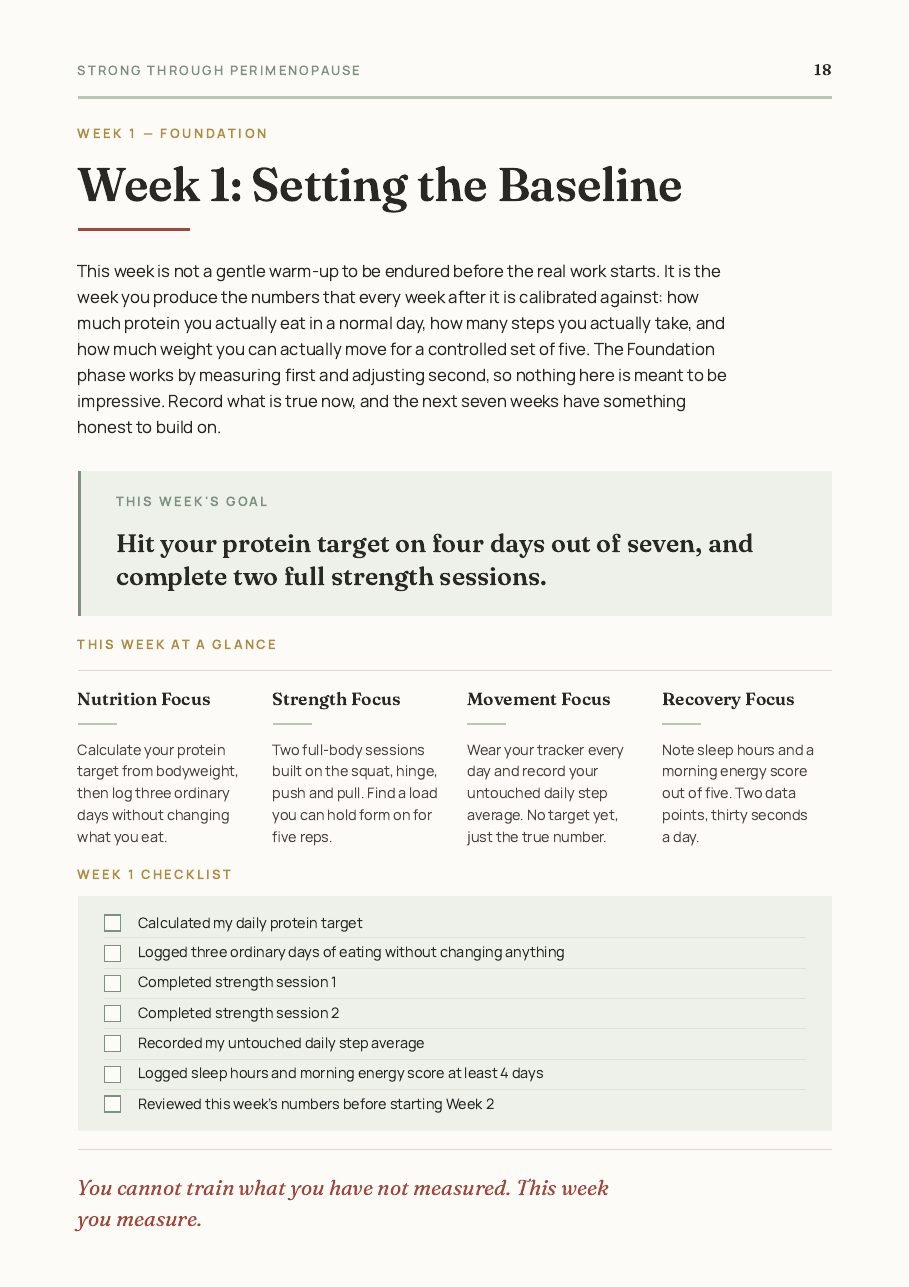
Every week scripted: one clear goal, the nutrition focus, the sessions, a short checklist and a reflection prompt.
An evidence-informed 8-week strength and nutrition programme for women in perimenopause — without extreme diets, endless cardio, or starting over every Monday.
80-page PDF · Instant download · One-time payment
Why the old approach stopped working
Same training. Same food. Different result. It isn't willpower, and it isn't your metabolism collapsing — as oestrogen falls, muscle's response to both training and protein is blunted. Physiologists call it anabolic resistance. The threshold moved.
Which is why the answer isn't more punishment. It's more precision: loads heavy enough to matter, protein in doses large enough to register, and recovery treated as an input rather than whatever is left over at the end of the week.
The scale can only tell you how much of you there is. It has never once told you what you are made of.
The method
Eighty pages, one idea in four forms. Every session, worksheet and tracker in the programme exists to support one of these four.
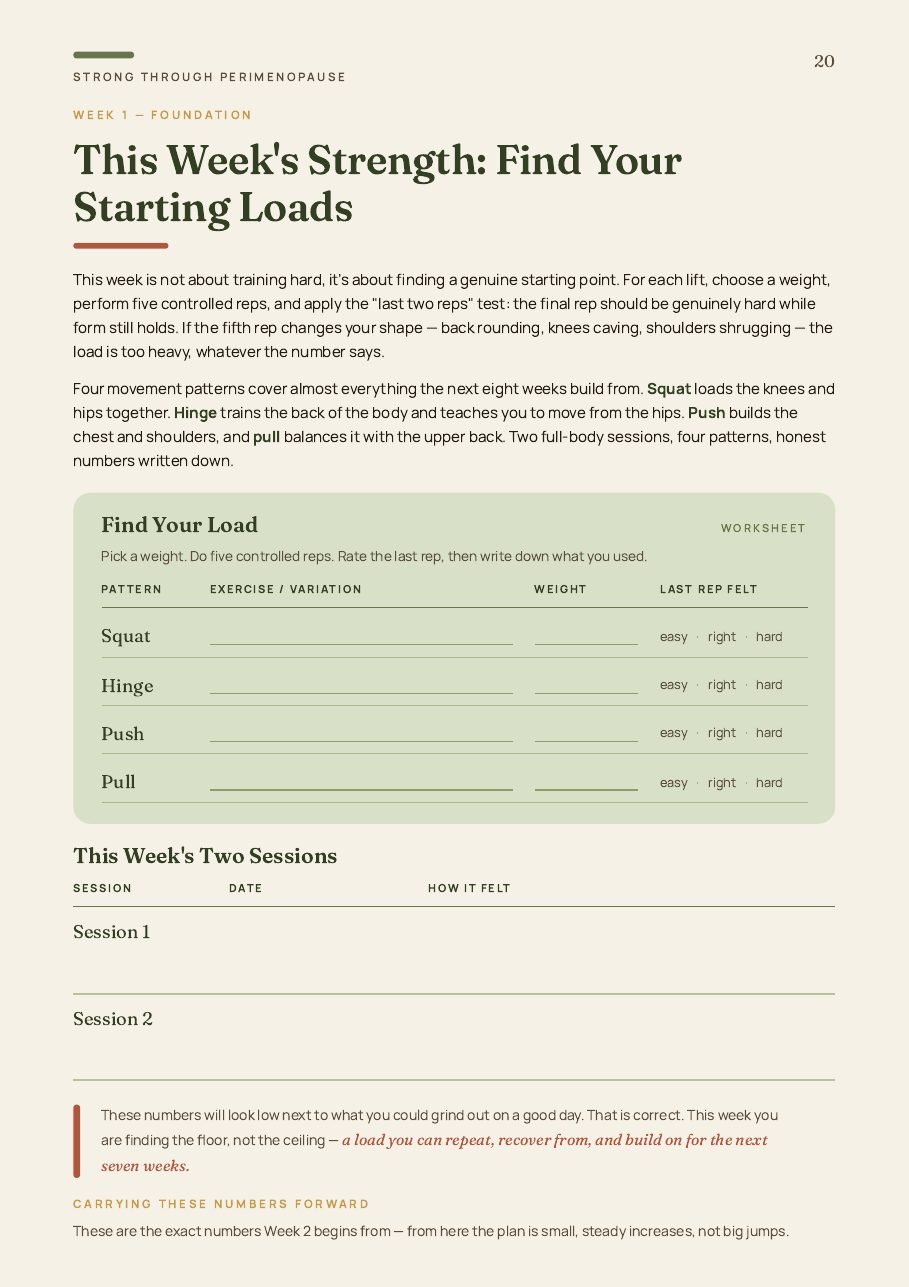
Two full-body sessions built on four movement patterns, with loads that climb in small, planned steps. This is the non-negotiable one.
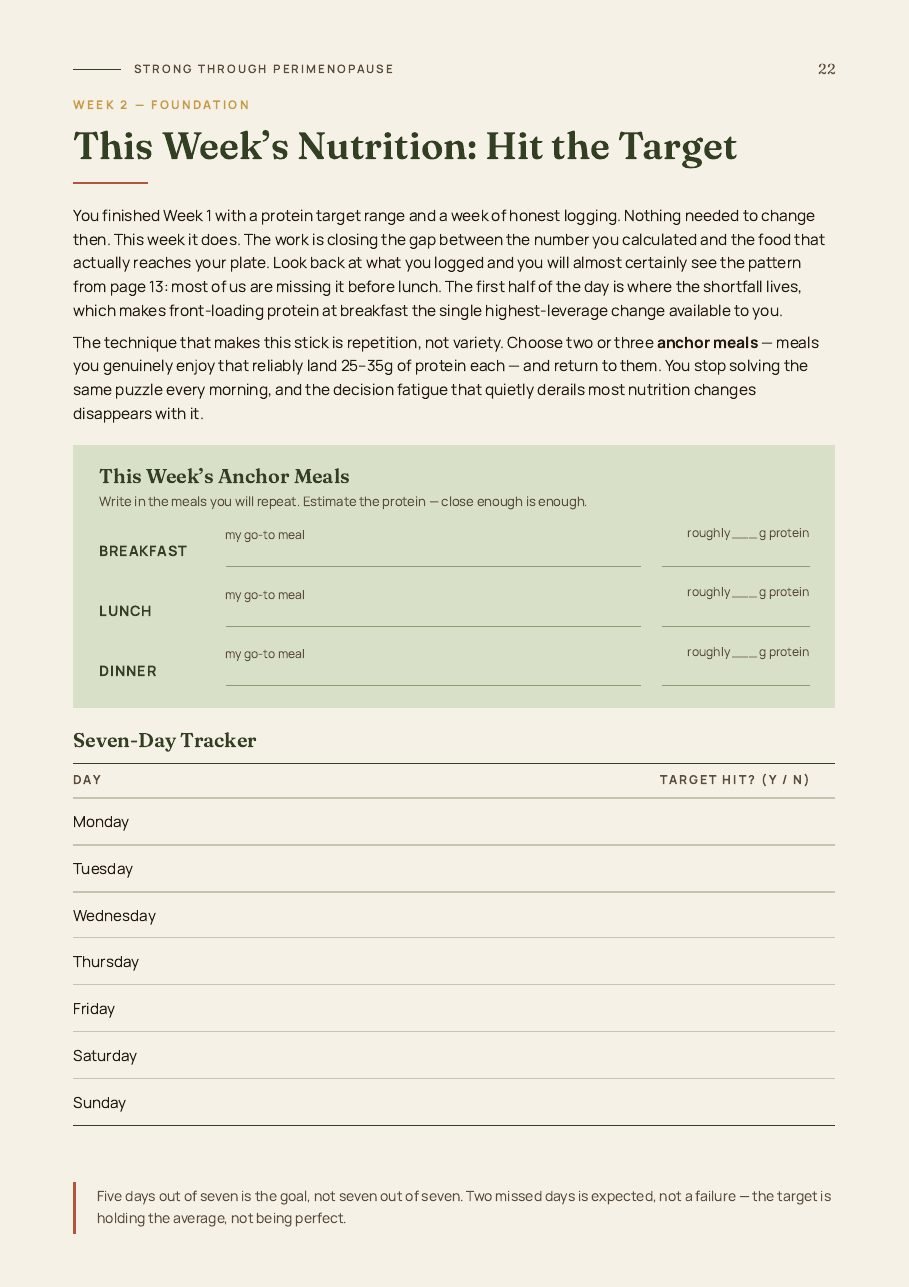
Distribution matters as much as the daily total. This is the signal muscle can actually act on — and most women miss it before lunch.
The two quiet inputs that decide how much of the training and the protein you actually get to keep.
One session, one meal, one bad night never undid eight weeks of consistency. Only a pattern can do that.
The eight-week programme is these four principles turned into a week-by-week structure — so you're never deciding what to do, only doing it.
What you get
Eighty illustrated pages covering the reasoning, the programme, and the tools you'll keep using long after week eight.
Every week scripted: one clear goal, the nutrition focus, the sessions, a short checklist and a reflection prompt.
Four movement patterns, two sessions a week, sets and reps specified, and a precise rule for when to add load.
Your protein target from bodyweight, anchor meals, post-session refuelling, and twelve thirty-gram meal combinations.
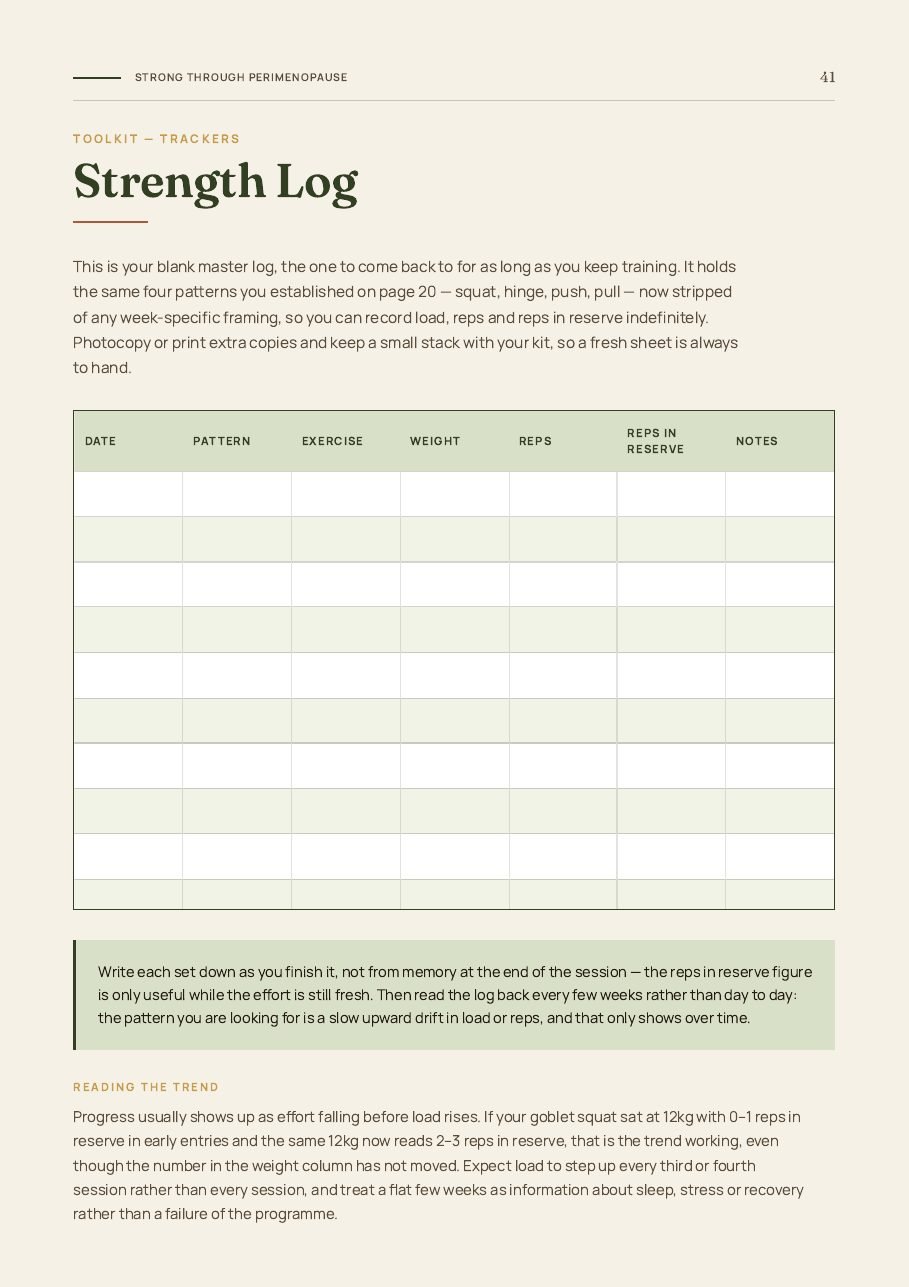
Strength log, nutrition and habit log, tape measurements and progress photo log — with spare copies included.
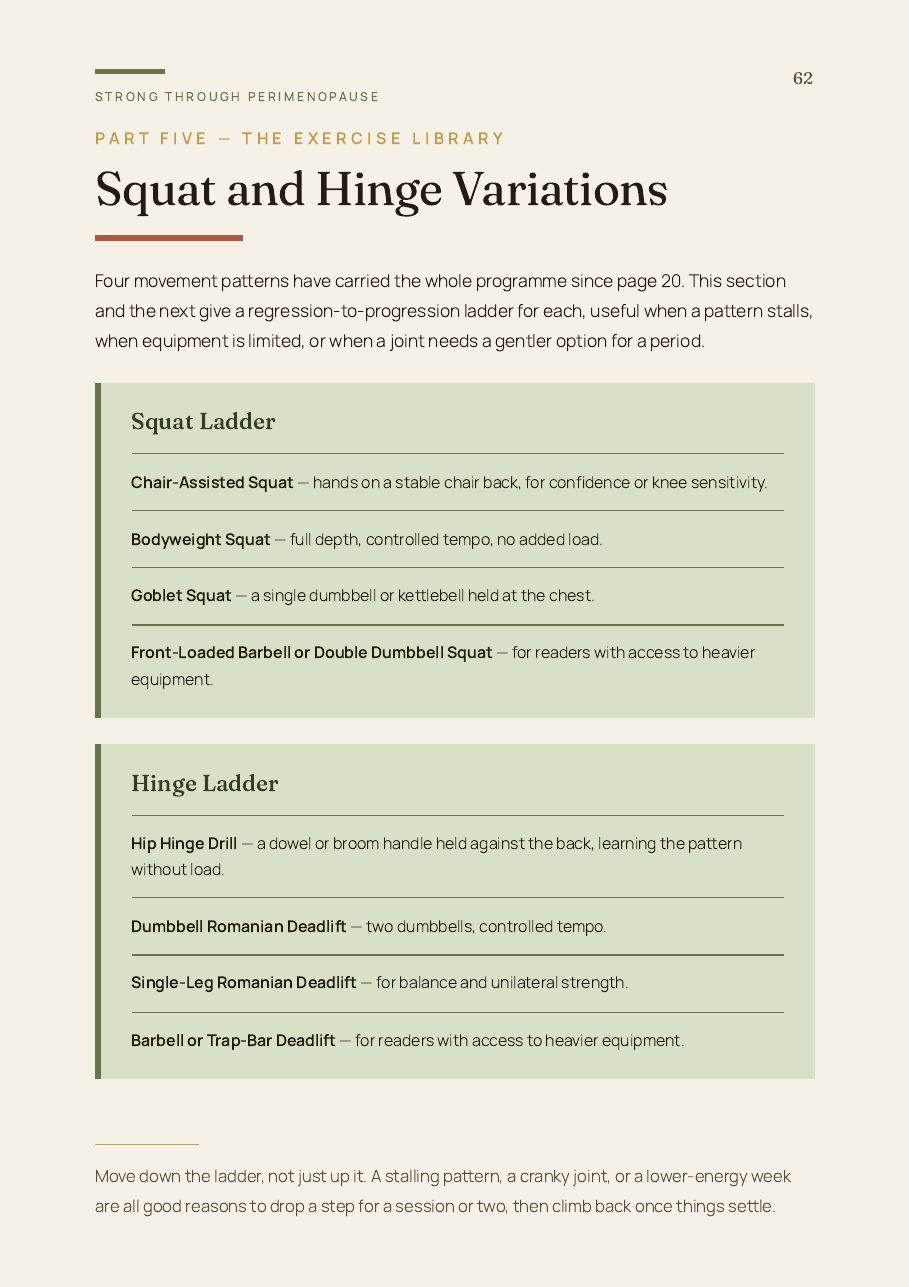
A regression-to-progression ladder for every pattern, plus core work and loaded carries. Home or gym, bands or barbell.
Troubleshooting a stall, planning a deload, handling travel and illness, and how to run your own cycles after week eight.
BONUS — INCLUDED WITH YOUR PURCHASE
Alongside the complete 8-week programme, you also receive these three practical resources as separate bonus files.
Printable Strength Tracker
Track your date, exercise, weight, reps, reps in reserve and notes so you can see your strength progress over time.
FILE NAME: Strength-Log.pdf
Your Practical Protein Guide
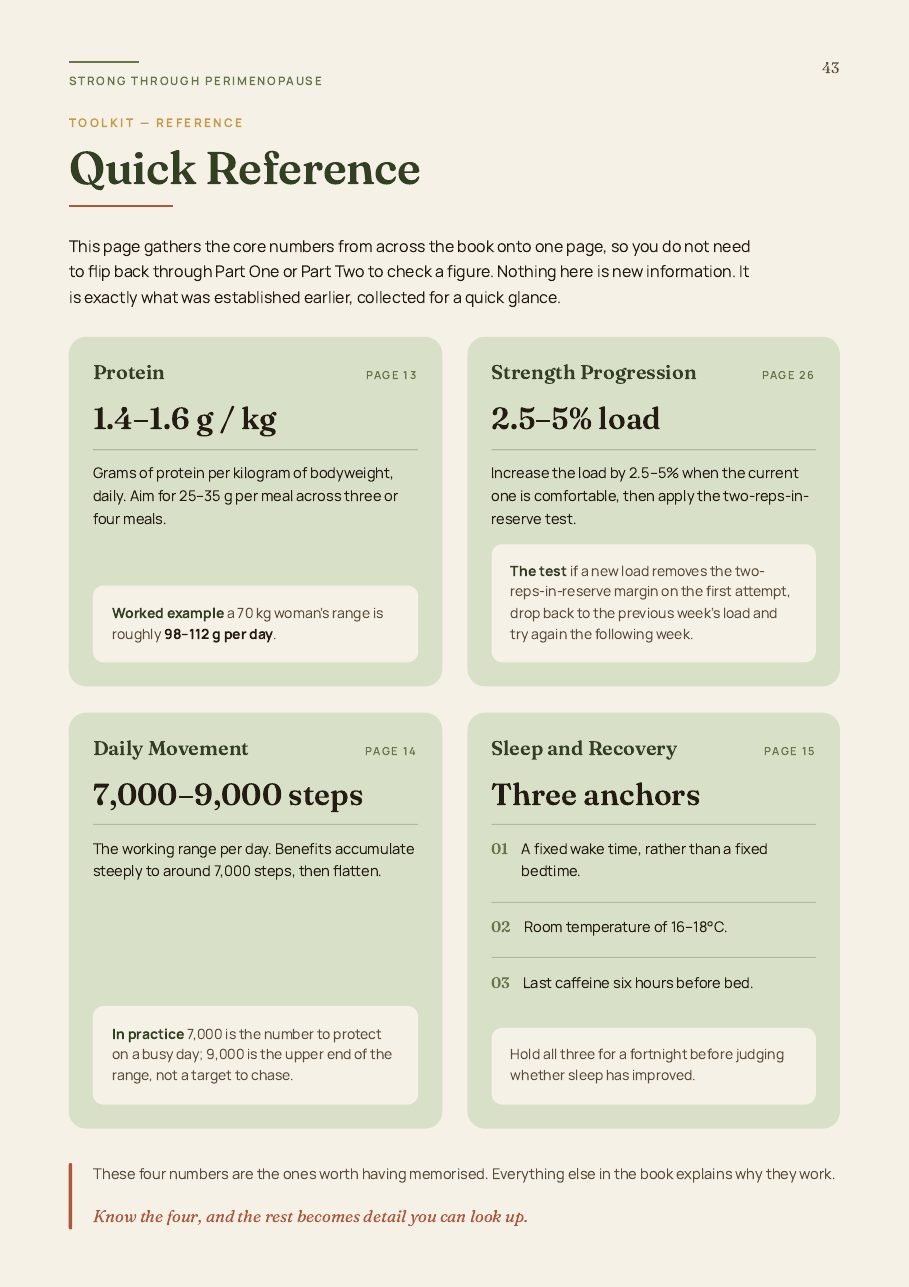
Includes the 1.4–1.6 g/kg per day starting point, simple distribution across 3–4 meals, and 12 meal ideas built around 25–35 g of protein.
FILE NAME: Protein-Starter-Guide.pdf
Quick Reference Habit Card
A simple reminder of the four key principles: strength training twice weekly, protein at meals, regular walking and sleep, and judging progress over weeks rather than days.
FILE NAME: Fridge-Card.pdf
Take a look inside
Real pages from the book — the weekly structure, the worksheets and the trackers you'll actually be filling in.
The 8-week roadmap
Every phase builds on the last, so nothing you do in week one is wasted by week eight.
Settle the basics: regular meals, short sessions, and honest starting numbers you can build on.
Add load and protein with intent. Progress starts showing up in the numbers, not the mirror.
Hold the gains and make the habits yours, so week nine looks after itself without a plan.
Who this is for
You don't need a training background to begin. Some readers have never picked up a weight; others trained seriously for years and stopped somewhere along the way. Wherever you're starting from, the eight weeks are designed to meet you there.
After eight weeks
The point isn't a number on a scale in week eight. It's being able to run this yourself, indefinitely.
From readers
★★★★★A practical approach to perimenopause that focuses on strength, protein and consistency instead of another restrictive diet.
Sarah M., 48
★★★★★I wanted something structured, but realistic enough to fit around work and everyday life. The two strength sessions a week make the approach feel manageable.
Emma R., 52
★★★★★What I like most is that the focus isn't just on the number on the scale. It explains why maintaining muscle matters and gives you an actual plan to follow.
Helen T., 46
The offer
Instant access. Yours to keep, print and reuse. Charged in USD.
Instant PDF download · One-time payment · Read on any device
Questions
You're taken straight to the download. The full 80-page PDF is yours immediately — no waiting, no drip-fed emails, no subscription. You can read it on a phone, tablet or laptop, and print the trackers as often as you like.
No. It gives you a daily protein target based on your bodyweight, a way to hit it using two or three meals you already enjoy, and twelve ready-made combinations that land in the right range. There's nothing to weigh and no foods removed.
No. Week one is spent finding your genuine starting loads rather than training hard, and every movement has an easier rung to begin on. Beginners also progress fastest early, because the first gains come largely from your nervous system learning to recruit what you already have.
No. Bodyweight and resistance-band variations exist for all four movement patterns, and the exercise library gives you a full ladder for each. The progression rule works the same way whatever you're lifting.
Two strength sessions of roughly 35–45 minutes including the warm-up, plus daily walking you mostly fold into your existing day. The programme is deliberately built around a full life rather than an empty calendar.
Yes. The principles it's built on don't expire at the twelve-month mark — muscle and bone still respond to load for the rest of your life. There's a section specifically on what changes after the transition and what stays the same.
No. The book is educational material designed around established principles of strength training and nutrition. It isn't intended to diagnose, treat or cure anything, and it isn't a substitute for a consultation with a doctor who knows your history. Speak to your GP before starting any new exercise or nutrition programme, particularly if you're managing a health condition or an injury.
One last thing
Strength in this decade isn't built by one transformative effort. It's built by ordinary weeks handled consistently — the session done on a tired Tuesday, the load nudged up when it's ready, the week resumed after one that didn't go to plan.
Get the 8-week plan — $19.97